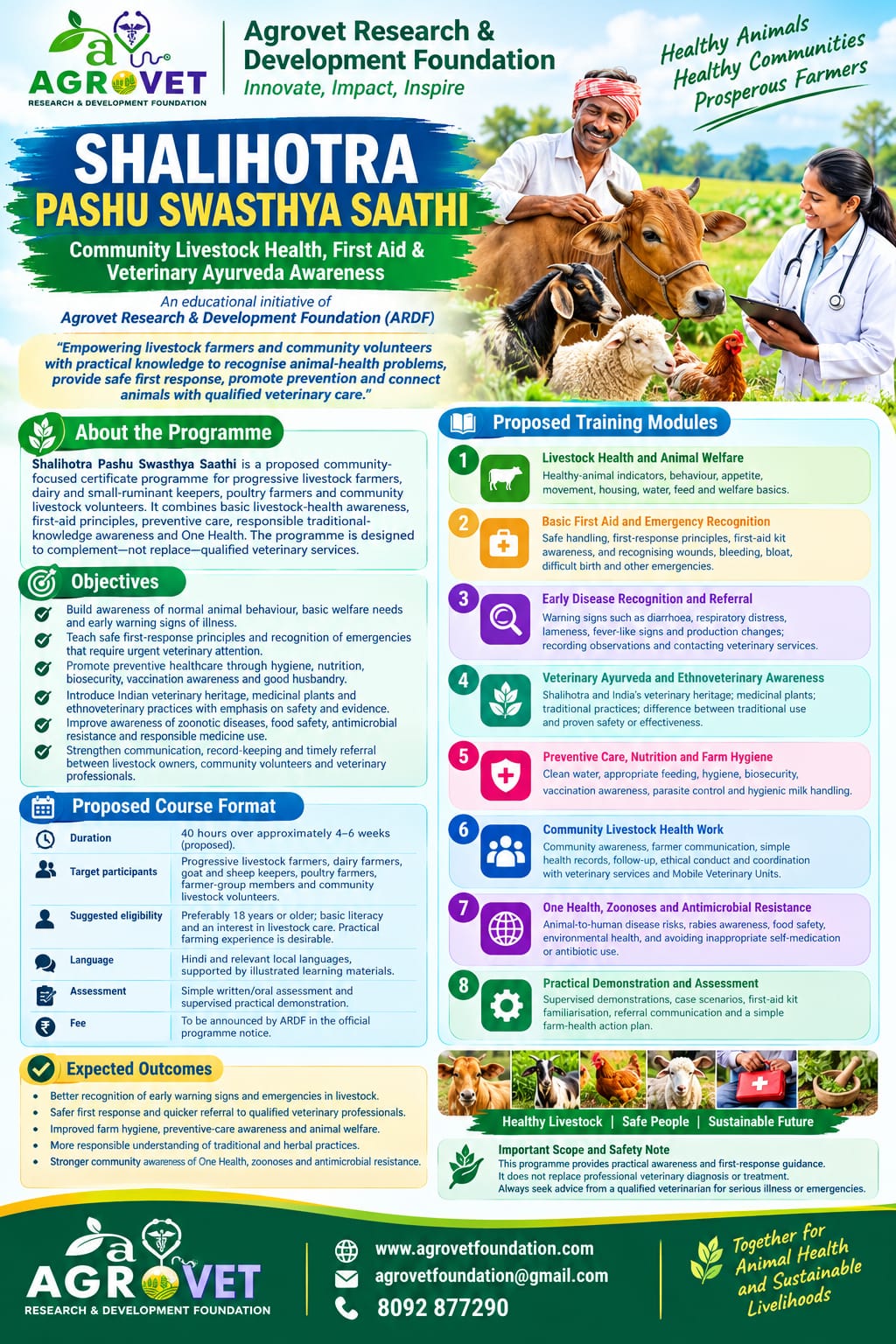
SHALIHOTRA PASHU SWASTHYA SAATHI
Community Livestock Health, First Aid & Veterinary Ayurveda Awareness
An educational initiative of Agrovet Research & Development Foundation (ARDF)
Empowering livestock farmers and community volunteers with practical knowledge to recognise animal-health problems, provide safe first response, promote prevention and connect animals with qualified veterinary care.
About the Programme
Shalihotra Pashu Swasthya Saathi is a proposed community-focused certificate programme for progressive livestock farmers, dairy and small-ruminant keepers, poultry farmers and community livestock volunteers. It combines basic livestock-health awareness, first-aid principles, preventive care, responsible traditional-knowledge awareness and One Health. The programme is designed to complement—not replace—qualified veterinary services.
Objectives
- Build awareness of normal animal behaviour, basic welfare needs and early warning signs of illness.
- Teach safe first-response principles and recognition of emergencies that require urgent veterinary attention.
- Promote preventive healthcare through hygiene, nutrition, biosecurity, vaccination awareness and good husbandry.
- Introduce Indian veterinary heritage, medicinal plants and ethnoveterinary practices with emphasis on safety and evidence.
- Improve awareness of zoonotic diseases, food safety, antimicrobial resistance and responsible medicine use.
- Strengthen communication, record-keeping and timely referral between livestock owners, community volunteers and veterinary professionals.
Proposed Training Modules
- Livestock Health and Animal Welfare
Healthy-animal indicators, behaviour, appetite, movement, housing, water, feed and welfare basics.
- Basic First Aid and Emergency Recognition
Safe handling, basic first-response principles, first-aid kit awareness, and recognising wounds, bleeding, bloat, difficult birth and other emergencies requiring veterinary help.
- Early Disease Recognition and Referral
Recognising warning signs such as diarrhoea, respiratory distress, lameness, fever-like signs and sudden production changes; recording observations and contacting veterinary services.
- Veterinary Ayurveda and Ethnoveterinary Awareness
Shalihotra and India’s veterinary heritage; traditional practices; medicinal-plant identification; the difference between traditional use and proven safety or effectiveness.
- Preventive Care, Nutrition and Farm Hygiene
Clean water, appropriate feeding, hygiene, biosecurity, vaccination awareness, parasite-control awareness and hygienic milk handling.
- Community Livestock Health Work
Community awareness, farmer communication, simple animal-health records, follow-up, ethical conduct and coordination with veterinary services and Mobile Veterinary Units.
- One Health, Zoonoses and Antimicrobial Resistance
Animal-to-human disease risks, rabies awareness, food safety, environmental health, and avoiding inappropriate self-medication or antibiotic use.
- Practical Demonstration and Assessment
Supervised demonstrations, case scenarios, first-aid kit familiarisation, referral communication, and a simple farm-health action plan.
Proposed Course Format
Duration | 40 hours over approximately 4–6 weeks (proposed). |
Target participants | Progressive livestock farmers, dairy farmers, goat and sheep keepers, poultry farmers, farmer-group members and community livestock volunteers. |
Suggested eligibility | Preferably 18 years or older; basic literacy and an interest in livestock care. Practical farming experience is desirable. |
Language | Hindi and relevant local languages, supported by illustrated learning materials. |
Assessment | Simple written/oral assessment and supervised practical demonstration. |
Fee | To be announced by ARDF in the official programme notice. |
Expected Outcomes
- Better recognition of early warning signs and emergencies in livestock.
- Safer first response and quicker referral to qualified veterinary professionals.
- Improved farm hygiene, preventive-care awareness and animal welfare.
- More responsible understanding of traditional and herbal practices.
- Stronger community awareness of One Health, zoonoses and antimicrobial resistance.
Important Scope and Safety Note
This is a proposed community education and awareness programme. The certificate does not by itself authorise independent veterinary practice, diagnosis, prescribing, injections or regulated veterinary procedures. Participants must work within applicable laws and their permitted scope, and seek a qualified veterinarian promptly for illness, injury, emergencies or suspected outbreaks. Traditional or herbal remedies must not be assumed safe or effective without appropriate evidence and veterinary guidance.
Programme Information
Agrovet Research & Development Foundation (ARDF)
Website: https://www.agrovetfoundation.com/
Admission details, training dates, fees and contact information will be announced through ARDF’s official website.
Email: agrovetfoundation@gmail.com
Mobile: 8092877290