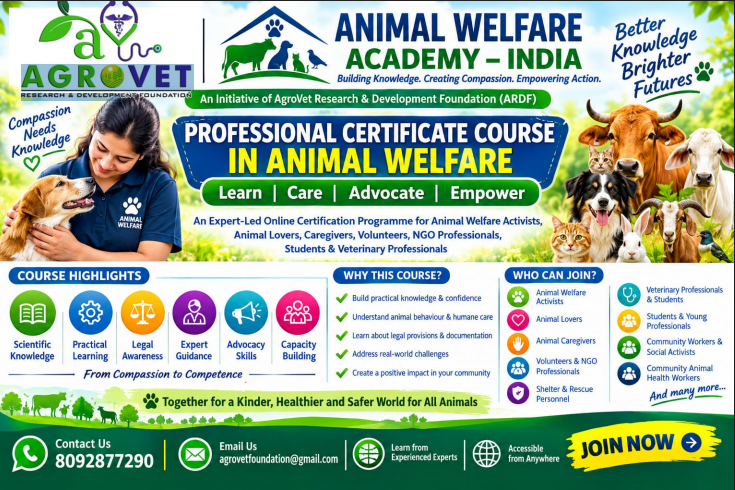
Building Knowledge. Creating Compassion. Empowering Action.
An Initiative of AgroVet Research & Development Foundation (ARDF)
PROFESSIONAL CERTIFICATE COURSE IN ANIMAL WELFARE
An Expert-Led Online Certification Programme for Animal Welfare Activists, Animal Lovers, Caregivers, Volunteers, NGO Professionals, Students & Veterinary Professionals
ABOUT ANIMAL WELFARE ACADEMY – INDIA
Animal Welfare Academy – India is an initiative of AgroVet Research & Development Foundation (ARDF) dedicated to promoting structured education, professional capacity building and responsible action in the field of animal welfare.
Animal welfare is not only about compassion. Effective welfare work requires knowledge, scientific understanding, humane practices, legal awareness, responsible communication and the confidence to work with communities and relevant authorities.
The Animal Welfare Academy – India aims to create a structured learning platform where individuals committed to animal welfare can acquire practical knowledge from experienced professionals and Subject Matter Experts.
The Academy will offer online certificate programmes, educational resources, expert-led sessions, awareness initiatives and capacity-building opportunities related to animal welfare.
PROFESSIONAL CERTIFICATE COURSE IN ANIMAL WELFARE
Learn. Care. Advocate. Empower.
The Professional Certificate Course in Animal Welfare is the flagship educational programme of the Animal Welfare Academy – India.
The programme has been designed for people who genuinely care about animals and want to understand how to work for animal welfare in a knowledgeable, responsible, humane and legally aware manner.
The programme combines:
Scientific Knowledge + Practical Learning + Legal Awareness + Expert Guidance + Advocacy Skills + Capacity Building
The objective is to help participants become more informed, responsible and confident in their animal welfare activities.
WHY THIS COURSE?
Across India, thousands of animal lovers, volunteers, caregivers, activists and NGOs work every day for the welfare of animals.
However, sincere intention alone may not always be sufficient.
Animal welfare activities can involve questions relating to:
– Animal behaviour
– Humane handling
– Rescue and rehabilitation
– Veterinary care
– Shelter management
– Animal cruelty
– Legal provisions
– Documentation
– Community conflict
– Responsible pet ownership
– Community animal care
– Dog population management
– Interaction with government authorities
– Public awareness
– Advocacy and communication
This programme aims to provide participants with a structured understanding of these areas.
Our objective is simple:
To transform compassion into informed and responsible action.
WHO CAN JOIN?
The programme is open to individuals from diverse backgrounds who have an interest in animal welfare.
Animal Welfare Activists
Individuals actively involved in animal protection, rescue, rehabilitation, awareness or advocacy.
Animal Lovers
People who want to understand animal welfare beyond compassion and develop practical knowledge.
Animal Caregivers
Individuals caring for companion animals, community animals, rescued animals or animals in shelters.
Animal Welfare Volunteers
Volunteers associated with NGOs, welfare organisations, rescue groups and community initiatives.
NGO & Social Sector Professionals
Professionals working with organisations involved in animal welfare, community development or One Health.
Animal Shelter & Rescue Personnel
Individuals involved in shelters, rescue centres, rehabilitation facilities and animal-care programmes.
Veterinary Professionals & Students
Veterinarians, veterinary students and allied professionals interested in animal welfare.
Students & Young Professionals
Students and young professionals wishing to develop a foundation in animal welfare.
Community Workers & Social Activists
Individuals working at the grassroots level who want to undertake animal welfare activities more effectively.
No prior professional qualification in animal welfare is mandatory. A genuine interest in animal welfare and commitment to humane practices are essential.
COURSE OBJECTIVES
By completing this programme, participants will be able to:
- Understand the fundamental principles of animal welfare.
- Understand the relationship between animal welfare, animal health and responsible human behaviour.
- Develop awareness of scientific and ethical approaches to animal care.
- Understand the broad legal and regulatory framework related to animal welfare in India.
- Recognise situations involving cruelty, neglect, suffering or poor welfare.
- Understand principles of humane animal handling.
- Develop basic knowledge of responsible rescue and rehabilitation.
- Understand fundamental principles of shelter and animal-care management.
- Understand community-level animal welfare challenges.
- Develop responsible animal welfare communication and advocacy skills.
- Understand when veterinary, legal or administrative professional assistance is required.
- Build greater confidence to participate in animal welfare initiatives.
- Develop a network-oriented approach to collaboration with veterinarians, NGOs, authorities and other stakeholders.
- Promote evidence-based, humane and legally responsible animal welfare practices.
COURSE STRUCTURE
The programme will consist of structured online learning modules supported by expert lectures, study materials, interactive sessions, case discussions and assessments.
MODULE 1
FUNDAMENTALS OF ANIMAL WELFARE
Key Topics
– Meaning and concept of animal welfare
– Animal welfare versus animal protection
– Animal welfare versus animal rights
– Animal sentience
– Five Freedoms
– Contemporary animal welfare concepts
– Animal needs and quality of life
– Ethical responsibilities towards animals
– Human–animal relationship
– Compassionate and responsible animal care
Learning Outcome
Participants will develop a clear conceptual foundation in animal welfare and understand why welfare must be approached scientifically, ethically and responsibly.
MODULE 2
ANIMAL WELFARE IN INDIA
Key Topics
– Evolution of animal welfare in India
– Development of animal welfare institutions
– Government and statutory institutions
– Role of veterinary professionals
– Role of NGOs and civil society
– Role of animal welfare volunteers
– Community participation
– Responsibilities of animal caregivers
– Importance of collaboration and coordination
Learning Outcome
Participants will understand the broader institutional ecosystem of animal welfare in India.
MODULE 3
ANIMAL WELFARE LAWS & LEGAL AWARENESS
Key Topics
– Introduction to animal welfare legislation in India
– Prevention of cruelty to animals
– Responsibilities of animal owners and caregivers
– Legal aspects of animal rescue and care
– Understanding cruelty and neglect
– Reporting and complaint mechanisms
– Role of authorities
– Documentation and record keeping
– Compliance considerations
– Responsible engagement with government authorities
Learning Outcome
Participants will develop practical awareness of the legal environment within which animal welfare activities are undertaken.
Important: This module provides educational and general legal awareness. It does not constitute individual legal representation or substitute for advice from a qualified advocate in a specific legal matter.
MODULE 4
HUMANE ANIMAL HANDLING & CARE
Key Topics
– Understanding animal behaviour
– Humane handling principles
– Reducing fear, stress and suffering
– Safe handling practices
– Basic welfare assessment
– Nutrition
– Shelter and environmental requirements
– Hygiene
– Recognising signs of illness and distress
– Recognising situations requiring veterinary intervention
Learning Outcome
Participants will gain practical awareness of humane handling and basic welfare requirements.
MODULE 5
ANIMAL RESCUE, REHABILITATION & REHOMING
Key Topics
– Principles of responsible rescue
– Rescue planning
– Safety considerations
– Initial assessment
– Temporary care
– Rehabilitation
– Veterinary coordination
– Documentation
– Identification
– Adoption
– Responsible rehoming
– Preventing abandonment
Learning Outcome
Participants will understand how responsible rescue should be approached and why rescue must be followed by appropriate care, rehabilitation and responsible rehoming where applicable.
MODULE 6
COMMUNITY ANIMAL WELFARE
Key Topics
– Understanding community animal issues
– Community engagement
– Human–animal conflict
– Responsible pet ownership
– Community animal care
– Public awareness
– Vaccination awareness
– Preventive animal health
– Humane dog population management
– Community participation
– One Health perspective
Learning Outcome
Participants will learn how to approach animal welfare issues at the community level through communication, cooperation and responsible practices.
MODULE 7
ANIMAL SHELTER & CARE MANAGEMENT
Key Topics
– Principles of shelter management
– Animal intake
– Record keeping
– Population management
– Nutrition
– Hygiene
– Biosecurity
– Environmental enrichment
– Disease prevention
– Volunteer management
– Emergency preparedness
– Adoption and rehoming systems
– Ethical standards for shelters
Learning Outcome
Participants will understand the fundamental requirements for responsible shelter and animal-care operations.
MODULE 8
ANIMAL CRUELTY PREVENTION & RESPONSIBLE RESPONSE
Key Topics
– Recognising animal cruelty
– Recognising neglect
– Identifying welfare concerns
– Responsible documentation
– Reporting suspected cruelty
– Appropriate escalation
– Interaction with authorities
– Safety considerations
– Avoiding confrontation
– Responsible public communication
– Protecting animal welfare during intervention
Learning Outcome
Participants will understand how to respond to welfare concerns responsibly without compromising animal, public or personal safety.
MODULE 9
ANIMAL WELFARE ADVOCACY & COMMUNICATION
Key Topics
– Understanding welfare advocacy
– Community awareness
– Public education
– Social media communication
– Responsible messaging
– Awareness campaigns
– Working with local institutions
– Engaging schools and communities
– Stakeholder coordination
– Evidence-based advocacy
– Building partnerships
Learning Outcome
Participants will develop the ability to communicate animal welfare issues in a constructive, responsible and evidence-informed manner.
MODULE 10
PROFESSIONALISM, ETHICS & LEADERSHIP IN ANIMAL WELFARE
Key Topics
– Ethical responsibilities
– Professional conduct
– Responsible advocacy
– Avoiding misinformation
– Documentation and transparency
– Respectful stakeholder engagement
– Working with veterinarians
– Working with legal professionals
– Working with government authorities
– NGO collaboration
– Leadership in community welfare initiatives
– Sustainable animal welfare programmes
Learning Outcome
Participants will develop a professional and ethical approach to animal welfare activities.
MODULE 11
ANIMAL WELFARE BOARD OF INDIA (AWBI): MANDATE, FUNCTIONS & INDIAN INSTITUTIONAL FRAMEWORK
Key Topics
- Statutory role and mandate of the Animal Welfare Board of India (AWBI)
• Prevention of Cruelty to Animals Act, 1960 and relevant rules/orders
• AWBI’s role in advising Government on animal-welfare law and rules
• Humane treatment and prevention of unnecessary pain and suffering
• Animal transport and welfare during transportation
• Performing animals and welfare safeguards
• Welfare of draught/working animals and reduction of burden and suffering
• Animal shelters, rescue homes, pinjrapoles and related welfare facilities
• Veterinary assistance, animal hospitals and medical-care considerations
• Humane slaughter and pre-slaughter welfare principles
• Humane education, public awareness and formation of responsible public opinion
• Cooperation and coordination with Animal Welfare Organisations, NGOs, veterinarians, local authorities and other stakeholders
• Responsible documentation, reporting and engagement with competent authorities
• Distinguishing AWBI’s statutory role from the role of other competent authorities
Learning Outcome
Participants will be able to explain the principal mandate and functions of AWBI, identify welfare situations falling within major areas of the Indian animal-welfare framework, and understand how to engage responsibly with competent authorities and recognised welfare stakeholders. This module is AWBI-mandate aligned and must not be presented as AWBI accreditation or endorsement unless separately obtained.
MODULE 12
ANIMAL WELFARE ASSESSMENT: FIVE FREEDOMS, FIVE DOMAINS & ANIMAL-BASED INDICATORS
Key Topics
- From resource-based assessment to animal-based assessment
• Five Freedoms as a foundational framework
• Five Domains model: Nutrition, Physical Environment, Health, Behavioural Interactions and Mental State
• Positive as well as negative welfare experiences
• Species-specific welfare needs
• Recognising pain, fear, distress, discomfort and abnormal behaviour
• Basic welfare checklists and scoring principles
• Quality-of-life considerations
• Case-based welfare assessment exercises
• Limitations of non-veterinary assessment and when professional intervention is required
Learning Outcome
Participants will learn to structure a basic, non-diagnostic welfare assessment using recognised concepts and to identify situations requiring veterinary, technical or administrative intervention.
MODULE 13
SPECIES-SPECIFIC ANIMAL WELFARE & RESPONSIBLE CARE
Key Topics
- Companion animals: dogs and cats
• Community animals and free-roaming dogs
• Farm animals: cattle, buffalo, small ruminants, pigs and poultry
• Working and draught animals
• Equids and other working animals
• Captive animals and zoo-related welfare principles
• Wildlife rescue and rehabilitation: basic principles and legal boundaries
• Laboratory/research animals: ethics, the Three Rs and institutional oversight
• Birds and small mammals commonly encountered in rescue settings
• Species-specific behaviour, housing, nutrition, enrichment and handling
• Referral pathways for veterinary and wildlife professionals
Learning Outcome
Participants will understand why welfare cannot be managed through a single generic approach and will learn to recognise major species-specific care and referral requirements.
MODULE 14
ANIMAL WELFARE IN DISASTERS, EMERGENCIES & COMMUNITY CRISIS RESPONSE
Key Topics
- Disaster preparedness for animals
• Heat waves, floods, cyclones, fires and other emergencies
• Evacuation and temporary shelter planning
• Animal identification, reunification and record keeping
• Emergency feeding, water, hygiene and biosecurity
• Safe rescue and handling during emergencies
• Coordination with local administration, veterinary services, NGOs and communities
• One Health, public safety and zoonotic-risk considerations
• Psychological stress and welfare risks during displacement
• Emergency communication and misinformation management
MODULE 15
ANIMAL WELFARE PROJECT, CASE STUDY & CAPSTONE ASSESSMENT
Recommended Practical Component
Each participant should complete one structured case study or mini-project, such as:
• Welfare assessment of a shelter or community-animal setting
• Responsible pet-owner awareness campaign
• Animal welfare education session for a school/community
• Rescue-to-rehabilitation case documentation
• Shelter improvement plan
• Humane handling and welfare checklist
• Community dog welfare and responsible population-management awareness plan
• AWBI-mandate-aligned public education activity
The project includes: problem identification, welfare concerns, evidence/observations, applicable legal or institutional framework, proposed humane intervention, stakeholder coordination, documentation and measurable outcome.
CERTIFICATION & QUALITY ASSURANCE FRAMEWORK
- Recommended learning volume: 30–40 total learning hours, combining live sessions, self-study, case learning and assessment.
2. Attendance requirement: minimum 75% live-session attendance. - Assessment: structured examination plus case-based questions; recommended pass threshold 60%.
4. Capstone: successful completion of one case study/mini-project.
5. Practical learning: at least two guided case discussions and one welfare-assessment exercise.
PROFESSIONAL CODE OF CONDUCT FOR CERTIFIED PARTICIPANTS
Participants should be encouraged to follow a simple code of conduct: humane treatment; respect for law and professional boundaries; no self-authorised veterinary diagnosis or treatment; no unsafe rescue activity; no public accusation without responsible documentation; confidentiality of sensitive case information; respectful communication with authorities and communities; avoidance of misinformation; and referral to qualified veterinarians, lawyers, wildlife authorities or other competent professionals whenever required.
EXPERT-LED LEARNING
The programme will be delivered by experienced:
– Animal Welfare Experts
– Veterinary Professionals
– Subject Matter Specialists
– Legal Experts
– Animal Care Professionals
– Academicians
– Experienced NGO/Welfare Professionals
– Other specialists relevant to specific modules
The objective is to provide participants with multi-disciplinary knowledge rather than a single-dimensional approach to animal welfare.
ACADEMIC & PROGRAMME LEADERSHIP
Dr. R. B. Chaudhary
Honorary Director – Animal Welfare Education & Training
AgroVet Research & Development Foundation (ARDF)
Dr. R. B. Chaudhary brings extensive experience in animal welfare education, institutional training, public communication and the broader animal welfare sector.
He has served in significant capacities associated with:
Animal Welfare Board of India (AWBI)
National Institute of Animal Welfare (NIAW), Government of India
He is also associated with animal welfare communication through Pashu Mitra.
His experience will contribute to the academic direction and development of the Animal Welfare Education & Training initiative of ARDF.
LEARNING METHODOLOGY
The course will follow a structured online learning model:
STEP 1
Expert-Led Online Sessions
↓
STEP 2
Study Materials & Learning Resources
↓
STEP 3
Interactive Discussions & Q&A
↓
STEP 4
Case-Based Learning
↓
STEP 5
Knowledge Assessment
↓
STEP 6
Course Completion
↓
STEP 7
ARDF Certificate in Animal Welfare
STUDY MATERIAL
Registered participants will receive structured study resources designed to support their learning.
Depending on the module, resources may include:
– Course notes
– Presentation material
– Reading resources
– Case studies
– Practical guidance documents
– Legal awareness resources
– Reference material
– Educational resources prepared by Subject Matter Experts
The study material will be intended for educational and capacity-building purposes.
LEGAL & ADVISORY GUIDANCE
Animal welfare work can involve legal, administrative and practical questions.
The programme will therefore provide general legal awareness and advisory orientation relating to animal welfare activities.
Participants may receive guidance on areas such as:
– Understanding applicable legal provisions
– Documentation
– Reporting mechanisms
– Appropriate communication with authorities
– Compliance awareness
– Responsible welfare advocacy
– Identifying when professional legal advice may be required
Important
The programme’s legal component is educational and advisory in nature. It does not automatically constitute legal representation, litigation services or an advocate–client relationship.
ADVOCACY & CAPACITY BUILDING
The programme goes beyond classroom learning.
Participants will be encouraged to develop the ability to:
– Educate communities
– Conduct responsible awareness activities
– Communicate welfare concerns
– Work constructively with stakeholders
– Support humane practices
– Encourage responsible animal care
– Promote evidence-based welfare initiatives
– Build local networks
– Collaborate with veterinarians, NGOs and relevant authorities
FROM LEARNING TO FIELD ACTION
The ultimate purpose of the programme is to help participants apply their learning responsibly in their respective communities.
After completing the programme, participants may use their knowledge in areas such as:
Animal Welfare Awareness
Animal Care & Responsible Ownership
Rescue & Rehabilitation Support
Shelter & Care Activities
Community Animal Welfare
Humane Animal Management
Animal Welfare Advocacy
Public Awareness & Education
Participants will be encouraged to work within applicable laws, professional boundaries and recognised welfare practices.
WHO WILL BENEFIT FROM THIS COURSE?
This programme can be particularly useful for:
Animal Welfare Activists
To strengthen their knowledge and professional approach.
Animal Lovers
To move from compassion to informed action.
Animal Caregivers
To improve the quality and responsibility of animal care.
NGO Volunteers
To develop structured welfare knowledge.
Shelter Workers
To understand fundamental welfare and management practices.
Veterinary Students
To develop broader awareness of animal welfare and community engagement.
Veterinarians
To strengthen multidisciplinary understanding of animal welfare.
Social Workers & Community Volunteers
To integrate animal welfare into community-level activities.
CERTIFICATION
Participants who successfully fulfil the prescribed programme requirements, including applicable attendance and assessment requirements, will receive:
ARDF CERTIFICATE IN ANIMAL WELFARE
Issued by:
AgroVet Research & Development Foundation (ARDF)
The certificate will recognise successful completion of the prescribed educational programme.
COURSE DELIVERY
Mode: Online
Training: Expert-Led
Faculty: Subject Matter Experts & Experienced Professionals
Study Material: Provided to enrolled participants
Interaction: Live Online Sessions / Q&A, as scheduled
Assessment: Applicable course assessment
Certification: ARDF Certificate in Animal Welfare
Course Duration: To be announced for each batch
Batch Schedule: To be announced
Course Fee: To be announced
FUTURE LEARNING OPPORTUNITIES
The Animal Welfare Academy – India is intended to develop into a broader platform for continuing education and capacity building.
Future programmes may include specialised training in areas such as:
– Animal Welfare Laws
– Animal Shelter Management
– Animal Rescue & Rehabilitation
– Humane Dog Population Management
– Community Animal Welfare
– Animal Welfare Advocacy
– Animal Welfare & One Health
– Responsible Pet Ownership
– Animal Welfare Communication
– NGO & Welfare Organisation Management
OUR VISION
A knowledgeable and empowered animal welfare community across India.
We envision a network of individuals who combine:
Compassion with Knowledge
Concern with Responsibility
Advocacy with Evidence
Action with Ethics
Care with Professionalism
OUR MISSION
To provide accessible, expert-led and structured education in animal welfare and empower individuals to contribute to animal welfare activities with greater knowledge, confidence, responsibility and awareness.
WHY ANIMAL WELFARE ACADEMY – INDIA?
EXPERTISE
Learn from experienced professionals and Subject Matter Experts.
ACCESS
Participate through an online learning platform from anywhere in India.
KNOWLEDGE
Receive structured educational and reference material.
PRACTICAL ORIENTATION
Understand real-world animal welfare situations.
LEGAL AWARENESS
Develop awareness of the legal and regulatory environment.
ADVOCACY
Learn responsible approaches to communication and welfare advocacy.
CONFIDENCE
Build knowledge and confidence for responsible field-level participation.
NETWORK
Become part of a growing community of people interested in animal welfare education and capacity building.
AN INVITATION TO ANIMAL LOVERS ACROSS INDIA
You may already love animals.
You may already rescue them.
You may already feed them.
You may already volunteer for them.
You may already work with an NGO.
But ask yourself:
Do you have the knowledge and confidence to do it more effectively and responsibly?
The Professional Certificate Course in Animal Welfare is designed to help you build that foundation.
Learn.
Understand.
Care.
Advocate.
Empower.
Become a More Informed Voice for Animals.
ENROLMENT & PROGRAMME ENQUIRIES
AgroVet Research & Development Foundation (ARDF)
Animal Welfare Academy – India
Programme Leadership
Dr. R. B. Chaudhary
Honorary Director – Animal Welfare Education & Training, ARDF
Programme Enquiries
Dr. Rajesh Kumar Singh
AgroVet Research & Development Foundation (ARDF)
Mobile / WhatsApp:
9431309542
Email:
agrovetfoundation@gmail.com
APPLY NOW
Take the next step towards becoming a more knowledgeable, responsible and confident animal welfare professional, volunteer, caregiver or advocate.
[ APPLY FOR THE COURSE ]
[ CONTACT US]-
[ DOWNLOAD COURSE BROCHURE ]
ANIMAL WELFARE ACADEMY – INDIA
Building Knowledge. Creating Compassion. Empowering Action.
An Initiative of AgroVet Research & Development Foundation (ARDF)
Learn • Care • Advocate • Empower