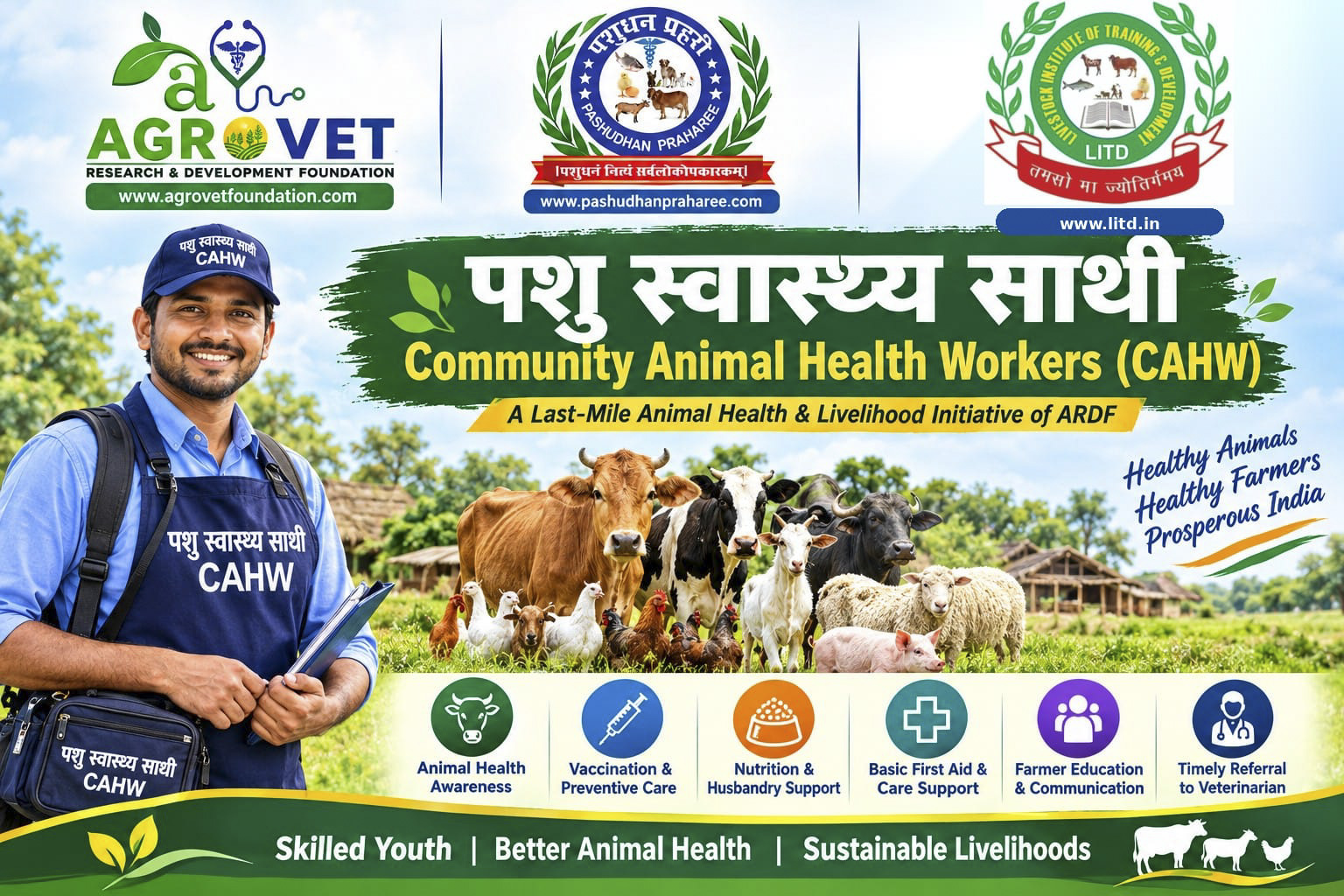
Community Animal Health Worker (CAHW) & Livestock Service Provider (LSP) Programme
A Last-Mile Animal Health & Livelihood Initiative of ARDF
PUBLIC CURRICULUM & TRAINING MODEL | 3 MONTHS / 12 WEEKS
Programme Introduction
The Pashu Swasthya Saathi Programme is a competency-oriented training initiative designed to develop a community-based cadre capable of supporting last-mile animal-health awareness, livestock husbandry, preventive care, basic permitted support services and timely veterinary referral in rural, semi-urban and underserved communities.
The programme is designed to complement, not replace, the services of Registered Veterinary Practitioners. The role and field activities of trained Saathis will remain subject to applicable laws, rules, notifications, authorisations and State-specific requirements.
Programme at a Glance
Item | Programme Details |
Programme Name | Pashu Swasthya Saathi |
Professional Descriptor | Community Animal Health Worker (CAHW) & Livestock Service Provider (LSP) |
Duration | 3 Months / 12 Weeks |
Delivery Mode | Classroom learning + practical training + supervised field exposure + competency assessment |
Implementing Organisation | AgroVet Research & Development Foundation (ARDF) |
Training Partner | Livestock Institute of Training & Development (LITD) |
Knowledge & Outreach Partner | Pashudhan Praharee |
Technical Support | Registered Veterinary Practitioners and qualified subject experts |
Target Group | Educated rural and semi-urban youth interested in livestock service and livelihood opportunities |
Programme Objectives
- Build practical knowledge of livestock husbandry and preventive animal health.
- Develop the ability to recognise common health problems, warning signs and situations requiring veterinary referral.
- Train participants in animal handling, basic first aid, wound care, hygiene, biosecurity and farmer communication within the permitted scope.
- Develop awareness of vaccination, parasite control, nutrition, reproductive management, neonatal care and disease prevention.
- Build awareness of zoonoses, rabies, antimicrobial resistance and One Health.
- Develop communication, digital record-keeping, service-delivery and basic livelihood/entrepreneurship skills.
- Establish a veterinarian-supported last-mile service and referral approach.
Expected Learning Outcomes
- Safely handle major livestock and poultry species using appropriate animal-welfare practices.
- Observe animals systematically and communicate relevant history and abnormal signs.
- Provide basic permitted supportive/first-aid assistance and follow referral procedures.
- Educate livestock owners on husbandry, nutrition, hygiene, biosecurity and preventive animal health.
- Recognise zoonotic-risk situations and promote safe practices.
- Maintain basic service and animal-health records.
- Use appropriate communication channels for consultation with a Registered Veterinary Practitioner.
- Work within the defined scope of the programme and applicable regulatory requirements.
Training Structure
Training Component | Recommended Hours |
Theory / Interactive Classroom | 180 |
Practical / Demonstration / Skills Training | 180 |
Supervised Field Exposure | 60 |
Final Assessment | 20 |
Total | 440 |
The final training schedule may be adjusted by the training institution according to local field conditions while maintaining the prescribed competencies and practical emphasis.
12-Week Curriculum
Week | Module | Key Learning Areas | Indicative Hours |
1 | Orientation, Professional Ethics & Basic Animal Science | Role and scope of the Saathi; animal welfare; professional conduct; basic anatomy and physiology; safe handling; occupational safety. | 20T + 15P + 5F |
2 | Livestock Husbandry & Farm Management | Cattle and buffalo; goats and sheep; pigs; poultry; housing, feeding, hygiene, identification, routine observation and records. | 15T + 20P + 5F |
3 | Animal Nutrition & Feed Management | Nutrients, fodder, ration basics, mineral supplementation, water, feed storage and recognition of nutritional problems. | 15T + 20P + 5F |
4 | Preventive Animal Health, Biosecurity & Hygiene | Biosecurity, sanitation, isolation/quarantine principles, disinfection, vector control and outbreak prevention. | 15T + 20P + 5F |
5 | Common Diseases & Clinical Observation | Recognition of common disease signs; history taking; basic observation; danger signs; reporting and referral. | 20T + 15P + 5F |
6 | First Aid, Wound Care & Emergency Recognition | Basic first aid, wound cleaning/dressing, bleeding control, dehydration recognition, injury management and emergency referral. | 15T + 20P + 5F |
7 | Vaccination, Parasite Control & Preventive Programmes | Vaccination principles, cold-chain awareness, records, deworming principles, ectoparasite control and preventive health calendars. | 15T + 20P + 5F |
8 | Reproductive & Neonatal Management | Heat detection, breeding management, pregnancy care, parturition preparedness, newborn care, colostrum and infertility warning signs. Regulated procedures only within applicable authorisation. | 15T + 20P + 5F |
9 | Species-Specific Health & Production | Dairy, small-ruminant, pig and poultry health/production management; mastitis awareness; young-stock care; flock observation and production records. | 20T + 15P + 5F |
10 | Zoonoses, Rabies, AMR & One Health | Rabies prevention, zoonotic diseases, One Health, antimicrobial resistance, food-safety awareness, PPE and community education. | 15T + 20P + 5F |
11 | Livestock Service Delivery, Digital Skills & Entrepreneurship | Farmer communication, service workflow, digital records, tele-support, referral documentation, entrepreneurship and professional ethics. | 15T + 20P + 5F |
12 | Integrated Field Practicum & Competency Assessment | Case-based exercises, supervised field exposure, referral drills, practical stations, written assessment and viva. | 15T + 15P + 10F + Assessment |
Core Practical Skills
- Safe restraint and handling of major livestock species
- Basic physical observation and vital-sign demonstration
- History taking and case-record preparation
- Body-condition assessment and basic production records
- Basic wound cleaning and dressing
- Bandaging and first-aid techniques
- Biosecurity, sanitation, disinfection and PPE procedures
- Vaccination and cold-chain handling principles
- Recognition of dehydration, shock and emergency warning signs
- Neonatal care and colostrum management
- Basic reproductive observation and farmer counselling
- Safe referral and sample-handling awareness
- Digital reporting and veterinarian tele-support etiquette
Veterinary Support & Referral Model
Every trained Pashu Swasthya Saathi should function within a defined scope and have access to a designated Registered Veterinary Practitioner or referral facility for professional guidance. The Saathi is not a substitute for a Registered Veterinary Practitioner.
Level | Role |
Pashu Swasthya Saathi | Permitted basic support, preventive education, observation, records and timely referral. |
Registered Veterinary Practitioner | Professional guidance, case review, diagnosis/treatment where legally appropriate, supervision and referral decisions. |
Referral Facility | Veterinary clinic/hospital, laboratory or other authorised facility for cases requiring advanced care. |
Examples of Referral Situations
- Severe injury or uncontrolled bleeding
- Suspected serious infectious disease or outbreak
- Difficult or prolonged parturition
- Suspected poisoning
- Severe respiratory distress, collapse or other emergency
- Neurological signs or suspected rabies
- Sudden unexplained mortality
- Any condition requiring diagnosis, prescription or a procedure outside the Saathi’s authorised scope
Assessment & Completion
Assessment will be competency-oriented and may include continuous learning activities, practical skills assessment, supervised field performance, written examination, practical/OSCE-style stations and viva voce.
Successful participants will receive a programme completion certificate from the authorised training organisation. The certificate will evidence completion of the training programme and will not, by itself, constitute a statutory licence to practise veterinary medicine or perform any regulated veterinary procedure.
Post-Training Support
- Veterinarian-supported consultation and referral network
- Digital programme/trainee identification where adopted by ARDF
- Periodic refresher and continuing-learning activities
- Case discussion and knowledge-sharing support
- Field monitoring and quality improvement
- Community feedback mechanism
Programme Quality Approach
- Competency-based practical training
- Qualified and experienced trainers
- Veterinarian-supported technical oversight
- Supervised field exposure
- Documented assessment and competency records
- Periodic review and improvement of training content
Legal & Regulatory Disclaimer
This programme is an institutional training initiative and should not be represented as a government qualification, statutory veterinary licence, or automatic authorisation to practise veterinary medicine. Field activities shall be undertaken only within the scope permitted by applicable central and State laws, rules, notifications, authorisations and competent authorities. Any regulated procedure, including reproductive or veterinary procedures, shall be covered and performed only where legally authorised and under the applicable professional framework.
Alignment & Reference Framework
The curriculum has been conceptually structured with reference to the competency-based approach promoted internationally for Community Animal Health Workers and to the Indian context of livestock service delivery. WOAH published Competency and Curriculum Guidelines for Community Animal Health Workers in 2024. The National Qualification Register also uses the term Livestock Service Provider (LSP) and identifies CAHW/AHW and related terminology in its description of that job role. This programme should not be described as equivalent to, accredited by, or endorsed by WOAH, the National Qualification Register, or any government authority unless separate formal recognition/accreditation has been obtained.
Suggested Public Tagline
“Taking Animal Health Services to the Last Mile.”
Pashu Swasthya Saathi — Learn. Serve. Refer. Support.
AgroVet Research & Development Foundation (ARDF) | Livestock Institute of Training & Development (LITD) | Pashudhan Praharee